Paper Leaks – The culprits smirking in plain sight !
September 10, 2026
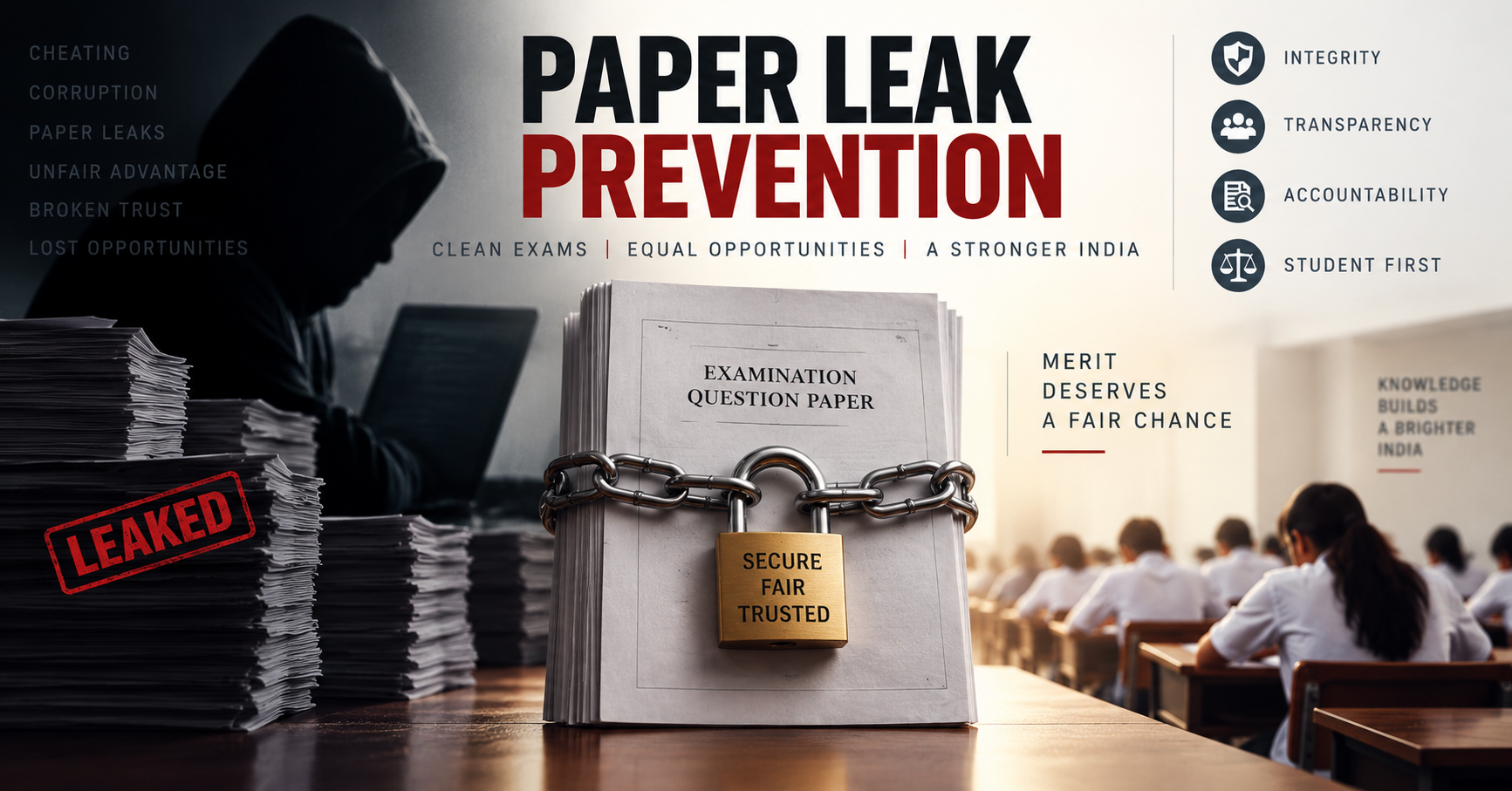
We Keep Treating Paper Leaks Like a Mystery, They Actually Aren’t.
Every time a major exam gets cancelled in this country, the reaction is the same. Shock, outrage, a promise of a fresh probe, and then silence until the next one happens. I’ve watched this cycle repeat for years, and at some point I stopped waiting for someone else to break it down properly. So I sat down one day and did it myself.
I went back through four of the biggest leaks of the last few years: REET 2021 in Rajasthan, the UP Police Constable exam in 2024, a Delhi Police recruitment exam, and NEET-UG 2024 at Hazaribagh. I wanted to know exactly where each one broke, not in general terms, but the actual point of failure. Which building, which person, which moment.
What I found surprised me less than I expected, and that was the initial the real problem. None of these four leaks were hacking cases. Nobody broke through a firewall or cracked a server. Every single paper leak case came down to a person standing somewhere they shouldn’t have been standing alone.
The paper doesn’t leak itself
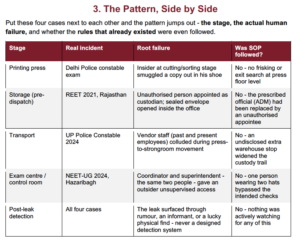
In Rajasthan, the REET paper wasn’t stolen from the press. It was taken from a storage office in Jaipur, two days before the exam, by someone who worked there. The role of custodian for that district was supposed to go to the Additional District Magistrate. Instead it had been handed to the head of a private outfit. Nobody hacked anything. Someone simply wasn’t supposed to be holding the key, and he was.
Action point: Never let the custodian role during storage go to anyone other than the officer the rules actually name. No informal hand offs, no convenient local substitutes, no exceptions.
In UP, the Police Constable exam leaked while the paper was on the road, moving between the printing press and the district strong room. The trail even ran through an extra, unnecessary stop at a warehouse in Ahmedabad before it reached UP at all. Fifty four people were eventually arrested. That’s not a lone insider having a bad day. That’s a network that knew exactly which gap to wait for.
Action point: Cut out unnecessary stops on the transport route, and never leave a private vendor alone with the consignment. A government officer should travel with the manifest every time.
Delhi Police’s exam leaked straight out of the printing press, in a shoe, carried out by an employee working the cutting machine.
Action point: Frisk press floor staff at every shift change, not just at the exam hall, and never let one person work the cutting and collating stage alone.
And at Hazaribagh, during NEET-UG, the same two people held both the official oversight role at the exam centre and the physical keys to the room where the papers sat. Nobody was checking on them because on paper, they were the ones doing the checking.
Action point: Separate the administrative coordinator role from the control room key holder role at every centre. The same person should never hold both.
Four different exams, four different states, four different agencies involved. And yet it’s the same failure wearing a different uniform each time. Someone unauthorised gets access, or one person ends up holding two jobs that should never sit with the same individual.
Why the usual response doesn’t work
After every leak, the response is almost identical. Cancel the exam, arrest a few people, promise tighter security, move on. Nobody goes back and asks why the existing rules weren’t followed in the first place, because in every one of these four cases, there were rules. They just weren’t enforced on the day that mattered.
That’s the part that convinced me a generic security tightening isn’t going to fix this. You can add more CCTV cameras and it won’t matter if the person meant to be watching the footage is the same person who let the leak happen. You can double the police escorts and it won’t help if the vendor moving the paper has staff who used to work there and still remember the route.
The fix has to match the failure, stage by stage. Question setting needs to stay sealed and split across people who never see the whole final paper. The Printing press needs frisking and a two person rule at the exact stage where sheets get cut and collated, because that’s precisely where Delhi Police’s leak happened. Storage needs the custodian role to go to whoever the rules actually name, never handed off informally, because that one broken rule is what caused REET. Transport needs a government officer riding with the manifest, not a vendor left alone with it, because that’s what UP taught us the hard way. And the Exam centre needs the person running the administration to be a different person from the one holding the control room keys, always, because Hazaribagh happened precisely because those two jobs sat with the same pair of hands.
None of this needs new technology to start. It needs someone willing to say plainly which stage failed and fix that stage specifically, instead of announcing a vague crackdown that fades in six months.
Where digital tools actually help
I’m not against technology here. Encrypted files, GPS tracked vehicles, biometric access logs, all of it adds real value once the human process underneath is sound. A split key encryption system means no single administrator can open the question paper file alone, which would have stopped Hazaribagh cold. A geofenced electronic seal on a transport vehicle would have flagged UP’s unauthorised warehouse stop the moment it happened, instead of investigators piecing it together weeks later.
But technology sitting on top of a broken process just gives you a more expensive version of the same failure. The digital layer should come after the human custody chain is fixed, not instead of it.
Now that you are reading this, think about this as well.
If you sit on an exam board, in a state education department, or anywhere near this system, the question worth asking isn’t “how do we prevent the next leak.” It’s narrower than that. Which of these four failure points, the press, storage, transport, or the exam centre, is weakest in your own process right now. We need to map it honestly once that is done then we need to fix the cheapest, highest impact gap first. In most cases that’s enforcing who is actually allowed to be the custodian of the paper, which costs nothing beyond the will to follow the hithero pre laid down rules.
I’ve written up the full process in detail, case by case, with the specific fix for each failure point and the digital controls that reinforce them. It’s not a theoretical framework. It’s built entirely from what has already gone wrong, four times, in public view. We don’t need to guess at this problem anymore, we just need to act on what it has already shown us. To read click here : Draft Paper Leak Prevention Policy
Quick summary, if you’re short on time
What the findings show: four major leaks, four different states, and every single one traces back to a human custody failure rather than a hack. An unauthorised person got access, or one person ended up holding two roles that should have been split between two people.
The action points, case by case:
- REET 2021: keep the storage custodian role with the officer the rules actually name, never an informal substitute.
- UP Police 2024: cut unnecessary transport stops, and never leave a vendor alone with the consignment.
- Delhi Police: frisk press floor staff every shift, and never let one person work the cutting stage alone.
- NEET-UG 2024, Hazaribagh: separate the coordinator role from the control room key holder role, always.
The SOP in one line: seal the paper at every stage, from setting through printing, storage, transport, and the exam centre, so that no single person ever holds both unsupervised access and zero oversight, and back that process with digital controls like encryption, GPS tracking, and biometric logs once the human chain itself is sound.