My thoughts that I penned on Earthday (April 22, 2026)
Today April 22, 2026, the world marks the 56th anniversary of Earth Day. What began as a bold American “teach-in” in 1970 has grown into the planet’s largest secular observance, uniting over a billion people across more than 190 countries every year. This year’s official theme from EARTHDAY.ORG is “Our Power, Our Planet”, a powerful reminder that environmental progress doesn’t wait for perfect governments or ideal political conditions. It depends on us simple ordinary people harnessing collective energy to protect the only home we have.
A Movement Born in Crisis
Flash back to 1970. Rivers in the United States were so polluted they literally caught fire. Smog choked major cities. Industrial waste flowed unchecked into lakes and oceans. Senator Gaylord Nelson of Wisconsin, inspired by the anti-war teachings of the 1960s, had a simple but revolutionary idea: What if we treated the environment with the same urgency ?
On April 22, 1970, an estimated 20 million Americans – 10% of the U.S. population at the time – took to the streets, parks, and campuses. They protested, cleaned up, and demanded change. The impact was immediate and lasting. By the end of that year, the U.S. Environmental Protection Agency was created, followed by landmark laws like the Clean Air Act and Clean Water Act.
Earth Day didn’t just spark policy – it ignited a global consciousness. Today, it continues to prove that when people mobilise, systems shift.
Why “Our Power, Our Planet” Matters in 2026
The theme for 2026 arrives at a pivotal moment. Recent years have seen record-breaking heat, extreme weather events, and pushback against environmental protections. Yet the message is clear and optimistic : the power to drive change lies with all of us.
“Our Power, Our Planet” emphasises accelerating the shift to clean, renewable energy. It calls for tripling clean electricity capacity by 2030, protecting biodiversity, and building resilient communities. It rejects the idea that environmental wins are fragile or reversible by vested interests. History shows that organised public action is unstoppable. In 2026, with global temperatures continuing to climb and biodiversity under pressure, the theme feels especially urgent and empowering. It’s not about Despair, it’s about Urgency.
Few Mind-Blowing Earth Facts to Spark Wonder
To truly appreciate what we’re protecting, we need to ruminate on these astonishing truths about our planet:
- Earth is the only planet in our solar system not named after a god – and the only one we know with liquid surface water and life.
- The Great Barrier Reef is the largest living structure on Earth and the only one visible from space.
- A single plastic bottle can take over 450 years to break down, while millions are produced every day.
- More than 15 billion trees are cut down annually – yet a single mature tree can absorb up to 48 pounds of CO₂ per year.
These aren’t just trivia. They’re reminders of the fragile, interconnected beauty we share – and the responsibility that comes with it.
Challenges We Face and Reasons for Hope
In 2026, the headlines can feel heavy: accelerating climate impacts, biodiversity loss, plastic pollution, water scarcity, and emerging issues like deep-sea mining or AI-driven environmental pressures. Scientists warn we’re close to overshooting 1.5°C of warming, with heatwaves, droughts, and ecosystem shifts becoming more intense.
But here’s the inspiring flip side: clean energy is booming. Solar and wind costs have plummeted. Communities worldwide are restoring forests, reviving rivers, and innovating solutions faster than ever. Youth activists, Indigenous knowledge holders, and everyday citizens are leading the way. Earth Day 2020’s 50th anniversary showed what’s possible even during a pandemic – over a billion people participated virtually. Progress isn’t linear, but it is real. And it starts locally.
For those who are uninitiated : Mind-Blowing “Rajasthan + Earth Facts”
- The Aravallis are older than the Himalayas – nearly 2.5 billion years old – and still serve as Rajasthan’s green shield against desert expansion.
- A single mature khejri tree (Rajasthan’s state tree) can support an entire desert ecosystem and sequester significant carbon depending on age and conditions, roughly 0.63 to 0.85 tonnes of carbon, contributing to reducing the greenhouse gases that cause climate change.
- Rajasthan’s solar parks now generate enough clean power to match the output of several large coal plants – every sunny day is literally Earth Day in action.
- The state is home to iconic biodiversity hotspots like Ranthambore (tigers), Sariska, Jawai and the Keoladeo wetlands (migratory birds), all protected under Rajasthan’s own State Biodiversity Board.
Globally, we’re still racing against 1.5°C warming, plastic pollution, and biodiversity loss. In Rajasthan, the twin pressures of desertification and water stress are immediate, yet the response is equally powerful. Rooftop solar is booming in Jaipur homes, school eco-clubs are thriving, and the Rajasthan Environment & Energy Conservation Centre (REECC) in Jaipur is already gearing up for 2026 environment awards and summits that celebrate local green champions.
Earth Day events in past years across Rajasthan, from sapling drives at Rajasthan Technical University to clean-ups and awareness programs they show the state’s youth and communities are ready to lead.
Rajasthan’s Solar Revolution: Powering the Future with the Desert Sun
Rajasthan has become India’s undisputed solar powerhouse. By the end of 2025, the state crossed around 36,658 MW of installed solar capacity – nearly 27% of India’s total solar output – thanks to more than 320 sunny days a year. Massive projects like the Bhadla Solar Park near Jodhpur continue to expand, while rooftop solar is transforming homes in Jaipur and beyond. Even with occasional transmission challenges, Rajasthan’s renewable energy capacity has surged past 41,000 MW, lighting up millions of households and cutting carbon emissions at breath taking speed.
This isn’t just megawatts on a chart. It’s ordinary Rajasthanis farmers, women self-help groups, and village entrepreneurs installing panels on rooftops and barren lands, turning scarcity into surplus. “Our Power” is literally harnessed from the sky every single day.
Cultural Resilience and Diversity: Where Tradition Meets Conservation
Rajasthan’s strength lies in its incredible human diversity and deep-rooted resilience. In the harsh Thar Desert, communities have survived centuries of water scarcity, sandstorms, and extreme heat not by dominating nature, but by coexisting with it. This spirit of humanity and balance is woven into the state’s social fabric. The Bishnoi community embodies this like no other: their 29 principles – no cutting green trees, no harming animals – turned conservation into a sacred, casteless duty. The 1730 Khejri tree sacrifice still echoes today as blackbucks and chinkaras roam freely in Bishnoi fields. This spirit ripples through Bhil and other tribal groups protecting sacred forests, and farmers reviving johads that bring back water, wildlife, and hope. The Aravallis ‘Earth’s ancient shield’ stand guard, while these traditions prove humanity thrives when it chooses balance over dominance. Today, in Bishnoi villages, blackbucks, chinkaras, and peacocks roam freely through fields. Women nurse injured fawns; entire communities guard sacred orans (groves) that recharge groundwater and shelter biodiversity. These practices aren’t “caste rules” in a rigid sense, Bishnoi philosophy welcomes all who follow the principles, transcending traditional hierarchies to create a casteless, ‘nature-centered’ way of life.
Gen Z Enthusiasm: The New Torchbearers Igniting Change
While elders guard ancient wisdom, Rajasthan’s Gen Z is injecting fresh energy and urgency into the movement. In December 2025, hundreds of young students and activists marched through Jaipur protesting threats to the Aravallis, demanding stronger protections for their city’s green lifeline. Universities and schools are buzzing with eco-clubs, while events like the Youth Eco Summit in Jaipur bring together thousands of students for workshops on e-waste, climate resilience, and green innovation.
Armed with smartphones and social media, Gen Z creators are driving a surge in eco-content, sharing stories of local clean-ups, tree-planting drives, and sustainable living. They’re not waiting for permission – they’re organising, protesting, innovating, and demanding accountability. Their enthusiasm proves that “Our Power” is actually intergenerational; grandparents teaching the value of a single Khejri tree, while grandchildren use apps to track solar output and rally friends for Aravalli restoration. Their energy is intergenerational, inclusive, & unstoppable.
Aravalli Green Wall and ‘Human Wildlife’ Coexistence: A Living Model of Harmony
The Aravalli Green Wall Project is already restoring tens of thousands of hectares with native seedlings, water-body revival, and biodiversity corridors. Tigers in Ranthambore and migratory birds in Keoladeo thrive because Rajasthanis have long practiced coexistence – wildlife isn’t managed; it’s welcomed as family.
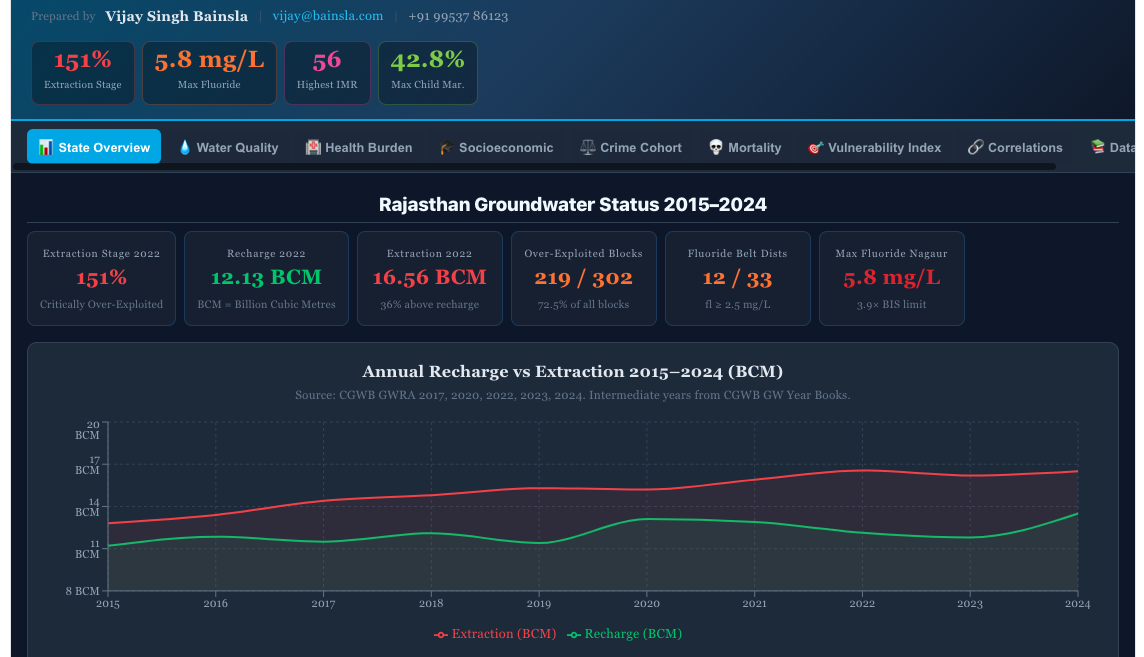
Challenges remain: desertification, water stress ( both surface & ground ), pollution, indiscriminate and un-cautioned industrial effluent discharge and occasional policy hurdles test this balance. Yet the same resilience that built johads centuries ago now appears to be supercharged by solar tech and youthful activism and a desire to leave the earth habitable for our next of kin.
Hitherto Untried Innovations: Rajasthan’s Bold, Imaginative Leap Forward (Mental horsing around)
While solar, johads, and the Green Wall form the proven foundation, Rajasthan’s unique blend of abundant sunshine, ancient wisdom, cultural diversity, and Gen Z creativity makes it the perfect testing ground for bold, efficient, never-before-tried solutions. I let my thoughts gallop guilt free on a extra dose of mental steroids contemplating on extremely out of the box solutions and ideas that are imaginative yet immediately doable, low-cost pilots that communities, youth groups, and the government could launch within months, delivering multiple wins for water, energy, biodiversity, conservation and livelihoods. Sharing a few of the of them which came to my mind ~ for your consumption and thoughts :
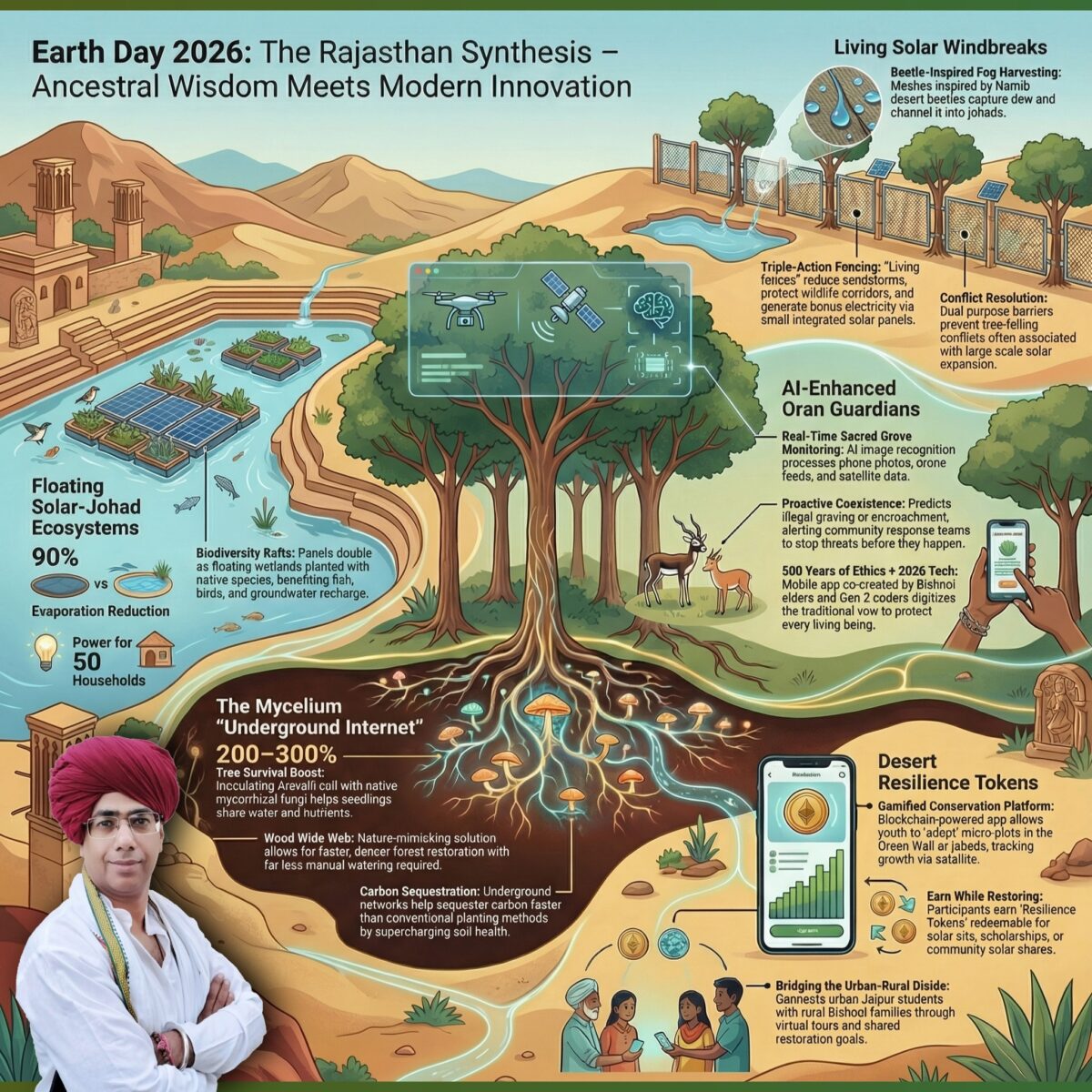
Floating Solar-Johad Ecosystems Imagine restored johads covered with modular floating solar panels that double as “biodiversity rafts.” The panels shade the water (cutting evaporation by up to 90% in the desert heat), generate extra clean power for nearby villages, and support attached floating wetlands planted with native aquatic species. Fish, birds, and groundwater recharge all benefit – a single pilot pond could power 50 households while creating a thriving mini-ecosystem. Untried at scale on Rajasthan’s seasonal water bodies, yet simple to assemble with existing solar tech and local materials. Bishnoi and farming communities could co-design them, turning every revived pond into a power-and-life hub.
AI-Enhanced Bishnoi Oran Guardians A mobile app co-created by Bishnoi elders and Gen Z coders that uses AI image recognition on phone photos, drone feeds, and satellite data to monitor sacred orans (groves) and wildlife corridors in real time. The system predicts threats like illegal grazing or encroachment and instantly alerts mixed community response teams – blending 500-year-old conservation ethics with 2026 tech. No more reactive protection; proactive coexistence that reduces human-wildlife conflict to near zero. Efficient, low-cost ( just smartphones + basic drones ), and scalable across diverse castes, tribes & communities – a digital extension of the Bishnoi vow to protect every living being.
Mycelium-Infused Aravalli “Underground Internet” During Green Wall planting drives, inoculate soils with locally adapted mycorrhizal fungi networks (the “wood wide web” that lets plants share water and nutrients underground, Mycorrhizal fungi establish a symbiotic relationship with plant roots, acting as an extension of the root system to drastically increase nutrient especially phosphorus and water uptake ). In lab tests elsewhere, these networks boost tree survival in arid conditions by 200–300%. Rajasthan could run the world’s largest field trial across Aravalli slopes – faster, denser restoration with far less water. Gen Z volunteers and tribal groups plant the seedlings; the fungi do the heavy lifting. A low-tech, nature-mimicking solution that supercharges traditional methods while sequestering carbon faster than conventional planting.
Gen Z “Desert Resilience Tokens” Platform A blockchain-powered app where young people from every background “adopt” micro-plots in the Green Wall or johads. They plant, monitor via satellite and photos, and earn redeemable “Resilience Tokens” for solar kits, scholarships, or community solar shares. Gamified challenges, leaderboards, and virtual tours make conservation addictive and inclusive – bridging urban Jaipur youth with desert Bishnoi families. Efficient because every token directly funds real restoration; imaginative because it turns Earth Day into a year-round, rewarding movement that rewards diversity and builds long-term stewardship.
Living Solar Windbreaks with Beetle-Inspired Fog Harvest Along solar parks and desert edges, plant “living fences” of native Khejri and acacia integrated with fog-harvesting meshes inspired by Namib desert beetles (Stenocara gracilipes : renowned for its ability to harvest water from early morning fog using specialised, bumpy, and waxy elytra). Tiny solar panels on the structures power small pumps that channel captured dew straight into johads. The fences reduce sandstorms, protect biodiversity corridors, generate bonus electricity, and prevent the very tree-felling conflicts solar expansion sometimes creates. A beautiful fusion of ancient Rajasthani wind-catcher architecture, modern renewables, and nature mimicry hitherto untested anywhere in the Thar but ready for pilot implementation with existing Green Wall teams.
These innovations are rough but they aren’t distant dreams. They build directly on Rajasthan’s strengths of solar abundance, cultural reverence for nature, resilient communities, and Gen Z’s digital fluency while solving multiple problems at once ~ water scarcity, desertification, biodiversity loss, and energy access.
The Takeaway: Power Flows Through All of Us
Earth Day 2026 in Rajasthan isn’t about one hero or one solution. It’s a beautiful mosaic: solar panels gleaming under the desert sun, Bishnoi elders protecting trees with their lives, Gen Z voices echoing through Jaipur streets, communities of every background choosing coexistence, and now a burst of imaginative, untested innovations that turn challenges into opportunities.
This is ‘humanity at its best’ resilient, diverse, rooted in ancient values of balance, propelled by youthful fire, and brave enough to try what’s never been tried before. The planet doesn’t need saving from afar. It needs the power we already hold in our traditions, our innovations, our compassion, and our collective will.
This April 22, whether you’re watching the sunrise over the Thar, hiking the Aravallis, piloting a floating solar-johad, or simply choosing a plastic-free day in your home just remember always : This is Our Power, Our Planet.
And then the question persists like a repetitive sledgehammer “What will YOU do with that power ?”
Let’s make 2026 the year Rajasthan doesn’t just celebrate Earth Day ~ it redefines it for the world with ideas as bold as its people. Hey Gentlemen & Ladies – The Earth is Talking ~ Who All Are Listening ?
The author can be reached at vijay@bainsla.com