I have spent most of my life watching Rajasthan’s potential get quietly drained away. Not by dramatic failures. By slow, invisible leaks.
A farmer in Nagaur waits 5 months for a crop insurance claim that should arrive in 14 days. A widow in Tonk keeps receiving her deceased husband’s pension for two years because no system flagged his death. A teacher in Sikar marks attendance from 80 kilometres away. A small factory owner in Bhilwara abandons a business registration because the 19-document queue never ends. The list is varied and bottomless !
None of these failures make headlines. Together, they cost Rajasthan over ₹20,000 crore every single year – in documented leakage, confirmed by the Comptroller and Auditor General of India, by the RERC, by the National Health Mission, by our own state departments.
I am not writing this as a political statement. I am writing this as someone who grew up watching these systems fail real people – communities I come from, constituencies I have walked, families whose struggles I have witnessed up close for decades.
After months of research, field-level data validation, and deep engagement with comparable reform outcomes across Maharashtra, Andhra Pradesh, Telangana, Karnataka, and Assam, I have authored what I believe is a comprehensive AI Governance reform framework ever proposed for Rajasthan:
Rajasthan AI Governance Policy 2026-2031 — A Detailed Approach
WHAT THIS POLICY COVERS
( Detailed Interactive Analysis https://bainsla-ai-governance-rajasthan.netlify.app/ )
Fifteen ministries | 33 districts | Every major revenue stream | Every major welfare delivery system.
The framework maps 33 specific AI interventions – from satellite circle-rate correction in Revenue & Land Records, to GST network fraud detection in Commercial Taxes, to smart meter analytics across our three power DISCOMs, to face-recognition attendance systems in 83,000 government schools.
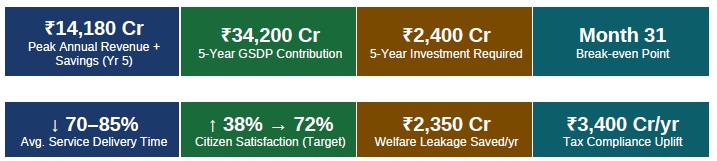
At steady state by FY 2030 – 31, the programme is projected to generate ₹14,180 crore in annual revenue recovery and cost savings – on a total five year investment of ₹2,400 crore. The return: approximately ₹37,300 crore over five years. Break-even by Month 28-31
WHY AI ? AND WHY NOW ?
I want to be honest about something: I am not a technologist by default. I do not write code by design and I believe that is precisely why this policy needed to be written by someone like me.
Because AI in governance is NOT A technology problem. It is a POLITICAL WILL problem. A TRUST problem. A LAST-MILE problem.
We have had biometric attendance systems in schools for years. Teacher absenteeism still worsened from 36% in FY20 to 41% in FY25 – because proxy fingerprinting evolved faster than detection. We have had Aadhaar seeding at 94% completion in our PDS system. PDS diversion is still at 18-19% – because death records are not cross-matched monthly. We have had mineral transit permits for decades. Mining royalty shortfalls are still 22% -because no one is doing satellite volume comparison.
The problem was never data. The problem was the absence of a system that connects the data and acts on it automatically, without requiring a human to do the connecting.
That is what AI does. Not magic. Just Connection of The Connecting Dots !
THE NUMBERS – AND THE CAVEATS
I want to be transparent about how these figures were derived – because credibility is everything when proposing a ₹2,400 crore public investment.
Every projected figure in this framework applies a 40% implementation discount to theoretical maximums. The 60% realisation rate used is the midpoint of IIM Ahmedabad’s State AI Readiness 2024 assessment range of 45-55%. No figure has been inflated for effect.
The SGST compliance uplift of 6% that forms the single largest intervention (₹2,660 crore net in Year 5) is not a guess – it is benchmarked against Maharashtra’s GST analytics programme which delivered 6.2% compliance improvement in Year 3. We used 6%, not 6.2%.
The AT&C loss reduction target (21.4% → 17%) is benchmarked against Andhra Pradesh’s DISCOM AI pilot, adjusted downward for Rajasthan’s desert feeder and agricultural load constraints.
Even at 50% realisation – half of what is projected – the programme still returns ₹18,650 crore on ₹2,400 crore invested. A 7.8x return.
Ask for the Detailed Policy PDF for detailed viewing of all 15 ministries, the point wise interventions for each ministry , the cost and result thereof .
WHAT THIS POLICY DOES NOT CLAIM
- It does not claim AI solves everything.
- It does not claim implementation will be frictionless.
- It does not claim the revenue projections are guaranteed.
What it does claim – backed by five years of verified state data from the CAG, RERC, GSTN, MoRTH, SRS, NHM and fourteen other primary sources – is that the cost of NOT acting is higher than the cost of acting.
Road deaths in Rajasthan have risen 30% in five years (22,116 to 28,720). Solar curtailment has grown 81% as renewable capacity was added without grid AI. Teacher absenteeism worsened despite biometric systems. PDS diversion has barely moved in six years of manual reform.
The status quo is not a neutral option. The status quo has a price. And it is being paid by people who have no voice in these decisions.
A PERSONAL NOTE
My extensive ground work for last 15 years with the Gurjar Arakshan Sangharsh Samiti, travelling 365 days a year across the length and breadth of Rajasthan , meeting all castes , income groups, diversified occupation groups, rural and urban splits has taught me one thing above everything else:
Communities do not distrust government because they dislike government. They distrust it because governments have given them specific, repeated, documented reasons to distrust it.
Every ghost pension. Every delayed crop insurance. Every BOCW worker who cannot access a welfare fund they contributed to – because a contractor skimmed the registration. AI governance, done right, is not surveillance. It is accountability. Accountability to the people the government exists to serve.
This policy is my attempt to build that case – rigorously, honestly, and with the voices of Rajasthan’s 33 districts in mind. I am happy to share the full 49 page policy document ( in case you wish to see the complete details ) , a detailed financial model covering all 15 ministries, an executive summary, and an interactive data dashboard openly. Not behind a paywall – Not to any political or commercial benefit.
The complete details of the data and impact jist is openly accessible at https://bainsla-ai-governance-rajasthan.netlify.app/
If you work in governance, public policy, technology, or development finance – I would value your review, your critique, and your collaboration.
Rajasthan deserves better AI enabled governance. And it can afford it – because the resources are already there. The Leak Just Needs To Be PLUGGED !
I would love to hear from you my email is vijay@bainsla.com
Vijay Singh Bainsla
DATA DISCLAIMER:
All historical figures (FY 2019-20 to FY 2023-24) are from Budget Actuals per CAG-audited Finance Accounts. FY 2024-25 figures are Revised Estimates (RE) from Rajasthan Budget 2025-26 and provisional departmental reports – final audited figures may differ by ±3-5%. Projected figures (FY 2026-27 to FY 2030-31) are model-based estimates derived from comparable state reform outcomes and should not be treated as guarantees of fiscal performance. The 60% realisation rate and 1.2x GSDP multiplier (NITI Aayog lower bound) are conservative assumptions applied uniformly. District-level impact figures are top-down allocations of projected state totals using economic share proxies – they carry ±25-35% uncertainty and are indicative, not precise. This document represents the author’s independent policy research and does not represent the official position of any political party, government body, or institution.
#RajasthanAI #AIGovernance #PublicPolicy #GoodGovernance #Rajasthan #DigitalIndia #PolicyResearch #GovTech #AIforIndia #VijayBainsla #RajasthanDevelopment #SmartGovernance